Good afternoon.
Kalinaw natong tanan.
Assalamu alaikum.
First I’d like to thank the organizers for having invited me in this forum. I will honestly share to you my thoughts on the present GPH-MILF peace talks from the perspective of a youth and student. I should confess that I’m no expert when it comes to the depth and width of the “Mindanao problem”, “Moro problem” or whatever you call it. Perhaps this is good because most of us the youth are not that informed or even aware on the complexities of this conflict and what are at stakes here. Hence, this presentation would represent the not-so-aware majority.
We are very busy uploading photos in facebook, downloading music and movies, and liking the statuses of our FB friends. Many of us also find pleasure in online games, DOTA, tetris, attending gigs, and malling. We can stay on-line for three hours or even more, but we’ll find it hard to stay in a two-hour forum on peace talks. As students, we are much focused in passing our subjects, getting good grades, in the hope that as we get good grades, we increase our chances of landing a good job in the future.
This is the sad reality of the status of most of the youth. We don’t seem to care on the events unfolding before our eyes, particularly the GPH-MILF peace talks. Of course, not all. I’ve also met fellow young people who care about this peace talks. But I could conclude they belong to the critical few.
In Mindanao State University-General Santos, the discussion on peace talks is limited within the classrooms---for those who are taking up AB Sociology, AB History, AB Political Science, AB Islamic Studies, and for those who are taking up History 3 (The History of Mindanao, Sulu, Palawan and Indigenous Peoples). I surmise that most of those who are taking up business, engineering, agriculture, education, and vocational courses are not interested in the peace talks. Perhaps it’s because they couldn’t connect the implications of peace talks vis-à-vis their daily living. The challenge for us, youth leaders is to provide venue for discussion to take place in a forum, seminar, or discussion group. These we will be doing this month and so on in various universities in Mindanao under Mindanao-one Youth Volunteers for Peace Network. It’s a newly organized group composed of campus and community youth leaders. It aims to “support the on-going GPH-MILF peace negotiations and ensure that the interests and welfare of the youth are reflected in the final agreement by influencing the process through advocacy work.”
But despite of the sad reality I’ve just mentioned, I still believe that the youth has a big role to play in the peace talks. Recognizing this, Prof. Cesar Adib Majul dedicated his book, Muslims in the Philippines, to the Muslim youth. Hashim Salamat also once said “we have planted the seeds of Jihad (struggle) and even if we pass away, the Bangsamoro people will carry on that Jihad towards the attainment of the goals and objectives of our struggle.” On this I believe he had the youth in mind.
We shall inherit whatever the result of this peace talks. It’s either you leave us a Mindanao where we (Muslims, Christian settlers, Indigenous peoples) could peacefully co-exist in the spirit of tolerance and justice; or you bequeath us a Mindanao filled with bloodshed and confusion, with people wallowing in a dire poverty and with my Bangsamoro friends carrying arms to continue the struggle.
It is the youth who are “severely affected by the conflicts as these could have limited the future possibilities for more peaceful and cooperative relations within society. It is indeed the youth who will play a key role in determining the relations in society will be more harmonious.” (Madelene Sta. Maria, 2003)
That’s why we are participating, and I’m one of those who responded to the call, realizing how great what is at stake here.
The GPH-MILF Peace Talks
As a student observer of the GPH-MILF peace talks, I am hopeful that both panels could come up with a win-win negotiated political settlement. I continue to hope taking into consideration what a deadlock or collapse of the negotiation could possibly result to. For those who are starting to lose patience in the negotiation, let us be reminded of Anwar Sadat, former President of Egypt, who once said, “Whenever the Israelis created problems during the peace negotiations, calculate again how much war had cost Egypt and Arab world since 1948.” (Sadat, 2009) In the Mindanao context, whenever there are problems or misunderstanding in the negotiation, calculate again how much war had cost Mindanao (and the whole Philippines) since 1970 (or even earlier than that).
The study of Campo and Judd (Salvatore Shchiavo-Ocampo, 2005) revealed the following estimated cost of war since 1970’s:
- About $ 2-3 Billion in direct economic costs
- An estimated 120, 000 deaths and uncounted numbers of wounded and disabled;
- Displacement of more than two million people, of whom almost half in 2000 alone, during President Estrada’s “all-out-war”;
- The emergence of “Muslim ghettoes” in various cities in Mindanao and elsewhere in the country made up of displaced persons and individuals forced out of their areas of residence owing to the disappearance of employment opportunities caused by the conflict;
- The exodus of illegal Muslim migrants to the neighboring state of Sabah, Malaysia;
- Increased incidence of poverty;
Not to mention the psychological effects on the children who lost a father, a mother, a brother or a sister. That cannot be quantified. Also, the loss of opportunity to education: how can we go to school if there’s war in our place.
Patience. Calculate once again.
How the MILF sees it
Upon listening to the news and reading related literature, this is how the MILF sees the problem, or at least my belief on how they see it.
The problem is sovereignty-based. We were once sovereign with our Sultanates. Mindanao is our home. We were never once conquered. Where were you Filipinos when we were fighting against the Spaniards and Americans? We are not the foreigners in our own land. There were attempts also to eliminate us using ILAGA’s. We were massacred during Martial Law. Our culture, religion, and identity were not respected. With government policy, we were systematically marginalized and driven away from our lands, and were considered “second-class citizens without any role in national decision-making”. We suffer injustices in this government. And we could allow it any longer. And so we arm ourselves. We defend our identity and reclaim our sovereignty.
We are not even given the chance to determine our own future and political status. We are fighting for our right to self-determination, a right that is even recognized by the United Nation.
With regards to the ARMM, it is found wanting. It’s not autonomy at all. It does not fully embody the desires and aspirations of the Bangsamoro people. What we are fighting now is what those lacking in the ARMM: ancestral domain, genuine self-governance, resources-sharing.
And truth be told, much as you want, we don’t want another war. We don’t want to pass this on to the next generation. We want this to be resolved in our time. And so we are submitting this Comprehensive Compact in the negotiating table. This embodies the desires and aspirations of the Bangsamoro people.
We no longer demand Independence, but a “symmetrical substate-state relationships, wherein powers of the Central Government and state government are clearly stated, aside from those powers [on which we shall] jointly exercise; like Hongkong-China relationship. This had already been utilized as way to resolve conflicts in South Sudan and Northern Ireland.
In resources, we demand 75-25 sharing in favor of the substate within the ancestral domain. This is just but modest demand. Stop the oil exploration in Liguasan Marsh and in Sulu Sea, as the negotiation continues.
With regards to the MILF combatants, we don’t want them to integrate in the PNP or AFP like what was done to MNLF. They shall be the security force who shall maintain the peace and order in the substate.
T
his is a win-win solution “that would benefit not only Moros and the Indigenous peoples, but also the Filipinos and government.” If you accept this as a working paper, we could fast-track the negotiation and resolve this decades-old conflict.
And so the MILF submitted this Comprehensive Compact last February 9-10 during the 20th GPH-MILF Exploratory talks. On the 21st Exploratory Talks (April 27-28, 2011), the GPH raised some queries regarding the Comprehensive Compact. It was then that they agreed that the GPH shall present their counter-proposal on the succeeding meeting. Then came the June 27-28 meeting, the GPH failed or deferred to present their counter-proposal, to the disappointment of the civil society and other stakeholders. The civil society released a position paper urging the GPH to submit its proposal.
On August 4, the nation was surprised that the President Aquino himself met with Chairman Al-Haj Murad in Tokyo, Japan. This increased the trust and confidence of the stakeholders and the MILF to the Pnoy Government. What was discussed in that meeting was confidential, but both agreed to fast-track the negotiation.
August 22-23, the 22nd Exploratory Talks, was the much-awaited date. In was in this time that the GPH submitted its counter-proposal. In the morning of that day (August 22), the OPAPP posted in their website the 11 Characteristics of the Government’s Counter-Proposal. And so I commented to myself, the negotiation might take a little longer. The MILF will surely be disappointed by this proposal.
This is how the government intends to solve the Mindanao Problem based on the 11 characteristics presented as I understand it. It’s like they are saying:
Putting aside your compact, we are presenting our counter-proposal, “an honestly different one”. This proposal contains a formula to achieve a comprehensive, just and lasting peace in our country.”
(1)You can trust this government and its good governance. We are sincere in dealing with you unlike the past administration. We would like to improve the quality of the lives of the people in partnership with you and rest assured that the Government will make use of the agencies to address the economic and social services for the Bangsamoro people.
(4 & 2)Let’s do the doables first. Let’s strengthen our relationship, develop understanding among Muslims and Christians and we’ll talk about the necessary Constitutional amendments in the future. Let’s not talk about the contentious issue yet on ancestral domain and substate concept.
(3)We are offering a solution that everybody will be happy: the MNLF, MILF, LGU’s. You should try to understand us that we are not dealing with the MILF alone, but with so many stakeholders. We are careful this time not to repeat the MOA-AD debacle. To reiterate, let’s work hand in hand to improve the socio-economic lives of our people.
(7)Let’s improve the ARMM and empower the Bangsamoro leaders. The ARMM per se is not a failure, though it has its own limitations. We should also consider that it failed partly because of its leaders and the national government. We will grant you a genuine autonomy where you could exercise your self-rule, etc, but please don’t insist on the substate yet. We can amend the ARMM organic act, to pave the way for a genuine autonomy.
(10)The substate proposal would not solve the problem. Let’s study this first and consult more stakeholders. Until we have a thorough consultation on this and increase of awareness on what is this all about, we cannot be with you on this substate. But please be assured that we understand the historical underpinnings of your proposal and your struggle for right to self-determination.
(11)We recognize your identity and history. We assure you that there shall be necessary retelling of your history which shall include its comprehensive narrative. We shall rewrite our books on history especially in the elementary and secondary education.
My guess is that the Government is trying to solve the Mindanao problem by addressing the socio-economic needs of the Bangsamoro people through a reformed and enhanced ARMM, in partnership with MILF and possibly with the MNLF. It’s hitting two birds in one stone. Constitutional amendment, to pave the way for substate, is not a priority of the Pnoy administration.
The MILF on the other hand has this reply: we’ve been there. Socio-economic services, ARMM…it didn’t work. Dropping our bid for independence, substate is our minimum demand to address our struggle for right to self-determination. We already agreed to talk about the ancestral domain with the last administration as one of the consensus points, and now you’re easily putting it aside without even commenting on the Comprehensive Compact?
Finding the Common Ground
The best thing that happened with the latest exploratory talks is this: it unveiled the thoughts of the government. Now starts the real negotiation. Where do we go from here? What is the common ground?
On this may I express out my humble opinions:
1. Both panels need to be more patient. MILF has been negotiating for the past fourteen years. Perhaps they won’t mind adding a year or two in trying to come up with a win-win solution. The GPH panels are new. The Pnoy administration is more than a year old. This should be taken into consideration by the MILF. They are not talking to Mr. Silvestre Afable and GMA. They are talking to new minds, with new different framework.
2. Both sides should maintain their trust and confidence, avoiding unnecessary remarks in the media which might cause misunderstanding with the other party.
3. Lay down to the table the two proposals. How about both sides making comment to each other’s proposals at least, and explain why the substantial points are negotiable or non-negotiable.
4. A third party may conduct a thorough research to determine what really is the perception of the Bangsamoro people in the ARMM with regards to the proposed substate. Should this be confirmed that it’s the desires of the large majority of the Bangsamoro, then the Government might reconsider her position. Until now this presentor still wonders if this really is what the people from Sulu, Tawi-tawi, Marawi, Maguindanao, etc, wanted.
5. Solidify the relationship between the MNLF-MILF. This is the missing link in the negotiation (in our desire for a peaceful Mindanao). Can the negotiated political settlement produce a lasting peace without the role of the MNLF in the process or at the outcome? How is the tri-partite review on the 1996 Final Peace Agreement going on? Can we have a peaceful Mindanao without the unity of the Bangsamoro people, specifically MILF and MNLF? Chair Murad and Chair Misuari should start talking to each other for the sake of the Bangsamoro people whom they both claim to legitimately represent. This perhaps is the main reason why the government doesn’t consider the proposed substate as a viable solution.
6. Can the civil society at least have a copy of the Government’s 3-for-1 proposal or its substantial points? Yes I understand the importance of the confidentiality of the negotiation to give both panels flexibility. But at this point in time, most of the Filipinos at least have an idea on the proposed substate stipulated in the Comprehensive Compact through media, while we don’t have any specific details of the Government’s. This is for the Civil Society to have an informed recommendation and not be left out on the development of the talks.
In closing, real negotiation has just started. This is the chance of Chair Murad and Pnoy to effect a just and lasting peace in Mindanao; same with Mr. Iqbal and Mr. Leonen. War is not an option. It should not be an option. Let the negotiation continue. We the youth are supporting the peace process together with all of you who are attending here.
I believe we can have peace in Mindanao. Paraphrasing Jimmy Carter’s statement--The blood of Abraham, God’s father of the chosen, still flows in the veins of Bangsamoro and Christian settlers in Mindanao, and too much of it has already been spilled. The spilled blood in the Land of Promise still cries out to God---an anguished cry for peace. “It is time to replace anguish with joy and celebration.” (Carter, 2009)
Peace is within reach. God bless Mindanao.
Thank you for listening.
Works Cited
Carter, J. (2009). My Hope For Peace. New York: Simon & Schuster.
The original text: The Blood of Abraham, God's father of the chosen, still flows in the veins of Arab, Jew, and Christian, and too much of it has been spilled grasping for the inheritance of the revered patriarch in the Middle East. The spilled blood in the Holy Land still cries out to God--an anguished cry for peace. It is time to replace anguish with joy.
Madelene Sta. Maria, P. (2003). The Filipino Youth's Participation in Conflict (A Paper Presented in the Conference on Global Perspectives on Youth Conflict, March 10-14, 2003). Retrieved March 28, 2011, from web.gc.cuny.edu/globalyouth/Chapters/StMaria.doc
Sadat, J. (2009). My Hope for Peace. New Yok City: Free Press.
Salvatore Shchiavo-Ocampo, M. J. (2005, February). The Mindanao Conflict in the Philippines: Roots, Costs, and Peace Dividend. Retrieved March 28, 2011, from www.internal-displacement.org/8025708F004CE90B/.../WP24_Web.pdf
The text on 11 Characteristics of the GPH 3 for 1 proposal was retrieved at OPAPP.gov.ph
The text on 11 Features of the MILF Comprehensive compact was retrieved from Mindanews.com
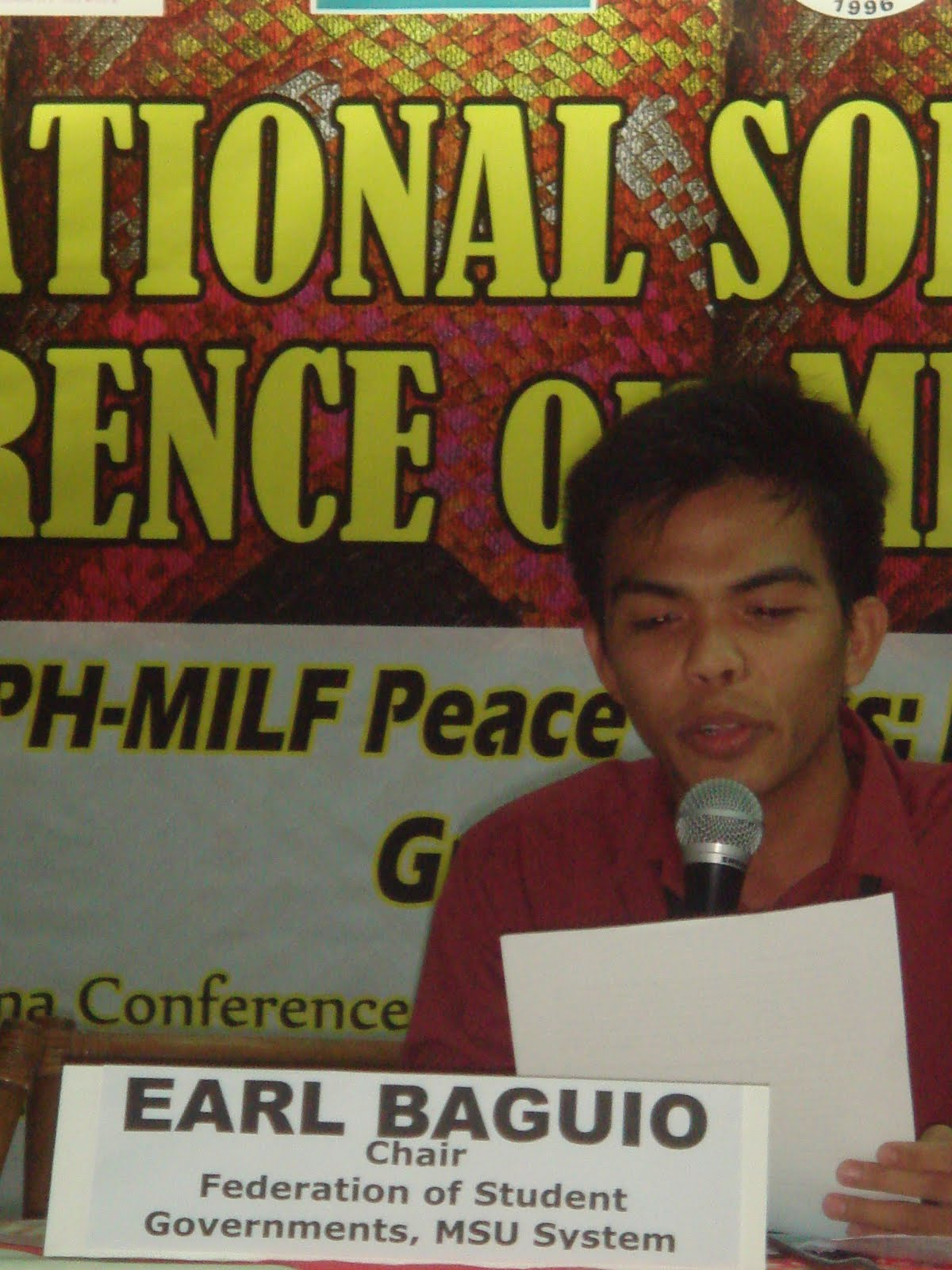
This piece was shared by a youth representative during the Second National Solidarity Conference on Mindanao on September 8, 2011, 5th Floor, Karpentrade Bldg, Mac Arthur High, Matina, Davao City. The event was jointly initiated by Mindanao People’s Caucus, Bishops Ulama Conference, Philippine Council of Evangelical Churches, Mindanao Solidarity Network, Consortium of Bangsamoro Civil Society, and International Alert.