Pages

Showing posts with label Bangsamoro Struggle. Show all posts

Tuesday, 25 October 2011

Know the TRUTH and please don't fan the flames

by Kahlil Urmila Virola Gardiola
Kahlil Urmila Virola Gardiola*


For the past two days, this status has been gaining popularity: I condemn the ABS CBN TV Patrol POLL dated October 20, 2011 for irresponsibly asking a complex question: "Papayag ba kayo na itigil na peace talks at mag ALL OUT WAR na laban sa MILF?" While 97% voted for YES, does this follow that 97% wants to stop the peace talks AND at the same time launch an ALL OUT WAR against the MILF? Let us not allow a question to compromise the peace talks. NO to sensationalizing of news and complex question. YES to fairness and accuracy of news! MEDIA, KNOW YOUR RESPONSIBILITY!!! [Please post this in your status until it reaches the mainstream]. It still riddles me as to the orginal source of the post, but it spread like wildfire over FB, specially among Mindanawons; Manilenyos; people from Luzon, Visayas and Pinoys based in other countries who are aware of what's really happening.

I am really saddened by the question AND result of the TV PATROL poll last October 20. Yes, there are lots of unfortunate things happening again here in the South. The majority of Filipinos are again prone to being drawn to confusion, irritation, anger, hatred, and worst--apathy. These flames are fanned further with misinformation; one-sided information; and people in positions who can greatly influence perception and sentiments. 

As your sister and fellow Filipino in our life journey, all I ask is for each of us to stay vigilant and always check and double check the information we are "handed" and most of all, not be influenced by black propaganda. For most people outside the conflict areas, especially those who don't know the real deal behind the issues, it all just seems confusing and pathetic, but for people here in Mindanao; specially those working on the ground; working for peace and trying to uphold the ceasefire and peace process (THIS ALSO INCLUDES mechanisms inside the Armed Forces of the Philippines and Moro Islamic Liberation Front such as the Joint Committee on the Cessation of Hostilities; Local Monitoring Teams; their subordinates, as well as International and Local representatives of the International Monitoring Team (IMT)--which I am also a part of). For these people working on the ground, and ESPECIALLY for people who LIVE WITHIN the conflict areas... every prejudiced word uttered, every wrong information, every decision made by people in high positions (mostly people in Manila and some who wants to protect their personal interests here in Mindanao), spells possible agitation, panic, violent conflict and displacement of thousands of families. 

In truth, if you don't already know, there are still hundreds of thousands of Internally Displaced People (evacuees) living in temporary shelters (because of the wars and some skirmishes before and after 2000, 2001, 2003, 2008 etc) up until now. The last thing we would want to happen again is an ALL OUT WAR like the one declared by Estrada in 2000. THAT WAR ALONE displaced almost a Million civilians. Yes, there are also internal conflicts such as RIDO, and some breakaway groups, but this only shows how complex the situation is, and how we are treading on fragile ground. Hence, it would be best if we leave the work to the authorities whose mandate is dealing with these particular issues--let them investigate and serve justice for those who deserve justice. Another unknown fact, for the past 10 years, since the the implementation of the Ceasefire Agreement between the Government of the Philippines (GPH) and the Moro Islamic Liberation Front (MILF), the communities are replete with success stories and life-saving experiences that are yet to be told and shared to a wider audience. Official records of the government and the MILF show 608 incidents of confrontation in 2002, which dropped to 10 in 2005 and only three in 2010. To add, when the government and MILF went back to negotiations, Mindanao experienced growth from 2005-2007, until clashes resumed in 2008 due to the controversies surrounding the now defunct MOA-AD.

 For those who are calling for an All Out War, DO NOT call for something out of emotional outrage, especially without even hearing the other side of the story; and without considering the huge implications of what you are suggesting. It has been a long arduous and painful journey towards peace... please do not compromise these efforts just 'cause you are feeling perplexed about things you see on mainstream media. Besides, let's not forget, that in the first place, all this struggle is rooted on the injustices done unto the Bangsamoro people. Justice for the Bangsamoro has long been overdue, and we are not making things better by spreading hatred against the Moros with misinformed and prejudiced declarations.

So, as your sister, I ask of you to please, please, stay cautious, get to know the real stories, don't spread the hatred and prejudice, help us achieve a lasting political settlement (to finally end all these), pray for us, whitelight, and just spread your love... ♥ Thanks and God Bless us all.

Ayyi "My TRUTH Empowers"

Read it at Facebook.com

*Photo from facebook.

Friday, 23 September 2011

Peace awareness in Kapeacetahan

Awareness is the starting point where change of behavior could take place. Positive awareness could motivate people to positively respond.

Before I didn't care about the Mindanao conflict as long as we were not affected directly. I live in one peaceful community in the province of Sarangani. We got no Muslim neighbors, which prevented me to understand how they live and behave.

By attending various forums  initiated by the UNYPAD, MUSA, and Young Moro Professionals in the University, I slowly learned what is their struggle all about.

That's why I find the peace awareness campaign of the OPAPP, the KAPEACETAHAN as equally important to the peace talks of the GPH and MILF. Massive awareness and education campaign is needed to augment and complement the talks. At the end, it will be the people who will decide, should there be a plebiscite on Constitutional Amendments. It will be the people, informed or not informed, will influence the actions of the politicians.

More programs like these are needed in the grassroots. There are many who are not yet aware of the conflict, and are deprived of an informed judgment.

Tuesday, 20 September 2011

The Peacemakers: MILF Peace Panel

The MILF Peace Panel

Chairman: Mohagher Iqbal
photosource:dl.voanews.cn
Mohaqher Iqbal, 62, is Information Chief Officer of the MILF Central Committee. He is also known by another name, as Salah Jubair, author of the book, Bangsamoro: A Nation Under Endless Tyranny and the 2006 book, The Long Road to Peace. Iqbal was panel chair from July 9, 2003 until the last agreement signed under the Arroyo administration on June 3, 2010. He was reappointed panel chair in early 2010.


Datu Michael O. Mastura
photos credit: cenpeg.org
Datu Michael O. Mastura, 69, is a lawyer and historian. He is also founding president of the Sultan Kudarat Islamic Academy Foundation in Sultan Kudarat, Maguindanao. A delegate to the Constitutional Convention in 1971, he later served as Deputy Minister of Muslim Affairs. He has written several books on the Bangsamoro Struggle, among them “Muslim in the Philippines”, The Muslim Filipino Experience: A Collection of Essays (1984), Islam and Development (1980) and has recently completed a new book “Bangsamoro Quest: The Birth of the Moro Islamic Liberation Front” which will be off the press soon.

Mastura served as representative of the first district of Maguindanao. He is now referred to as “senior panel member”. He has been a panel member since 2001.

Maulana Alonto
Maulana Robert Alonto, writer and activist, has been a panel member since 2003. He used to edit a community newspaper. He is based in Lanao del Sur. In the early 1970s, Alonto was with the Northern Mindanao Revolutionary Committee of the Moro National Liberation Front tasked to handle propaganda and “like the other brothers had to fight in the Moro war of Liberation and defense against the Marcos dictatorship.

Abhoud Syed Lingga
Prof. Abhoud Syed Linga, 61, Executive Director of Institute of Bangsamoro Studies in Cotabato City, and Chair of the Bangsamoro People’s Consultative Assembly, is a new member of the peace panel. He is a member of the Board of Directors of the Datu Ibrahim Paglas Memorial College. Like Iqbal and Mastura, Lingga has written several papers on the Bangsamoro Struggle, published in the Philippines and abroad.


Abdulla U. Camlian
Abdulla U. Camlian, a Tausug-Sama Bangui-ngui from Zamboanga City and Basilan, is a former head of the MILF peace panel’s technical committee. A graduate of the Cairo Military Academy in 1965, Camlian founded that year the Green Guards, “an associate idealist Muslim youth…which eventually formed the nucleus of Moro National Liberation Front (MNLF) in Western Mindanao.” He served the Southern Philippines Development Authority for several years and in 1989 was Deputy Executive Director with the rank of Assistant Secretary, of the Office on Muslim Affairs under the first Aquino Administration.
In 1990, he was named as member of the Philippine Lobby Mission to the Organization of the Islamic Conference (OIC) in Baghdad, Iraq, in Riyad, Saudi Arabia, in Morocco and in Kuwait. He had been assigned also to head the Philippines delegation to the International Qur’an reading competitions in some ASEAN countries.


Datu Antonio Kinoc, a Blaan, is alternate member of the MILF peace panel.


Source: Page 11, Our Mindanao, Volume 1 Issue 1, December 2010.
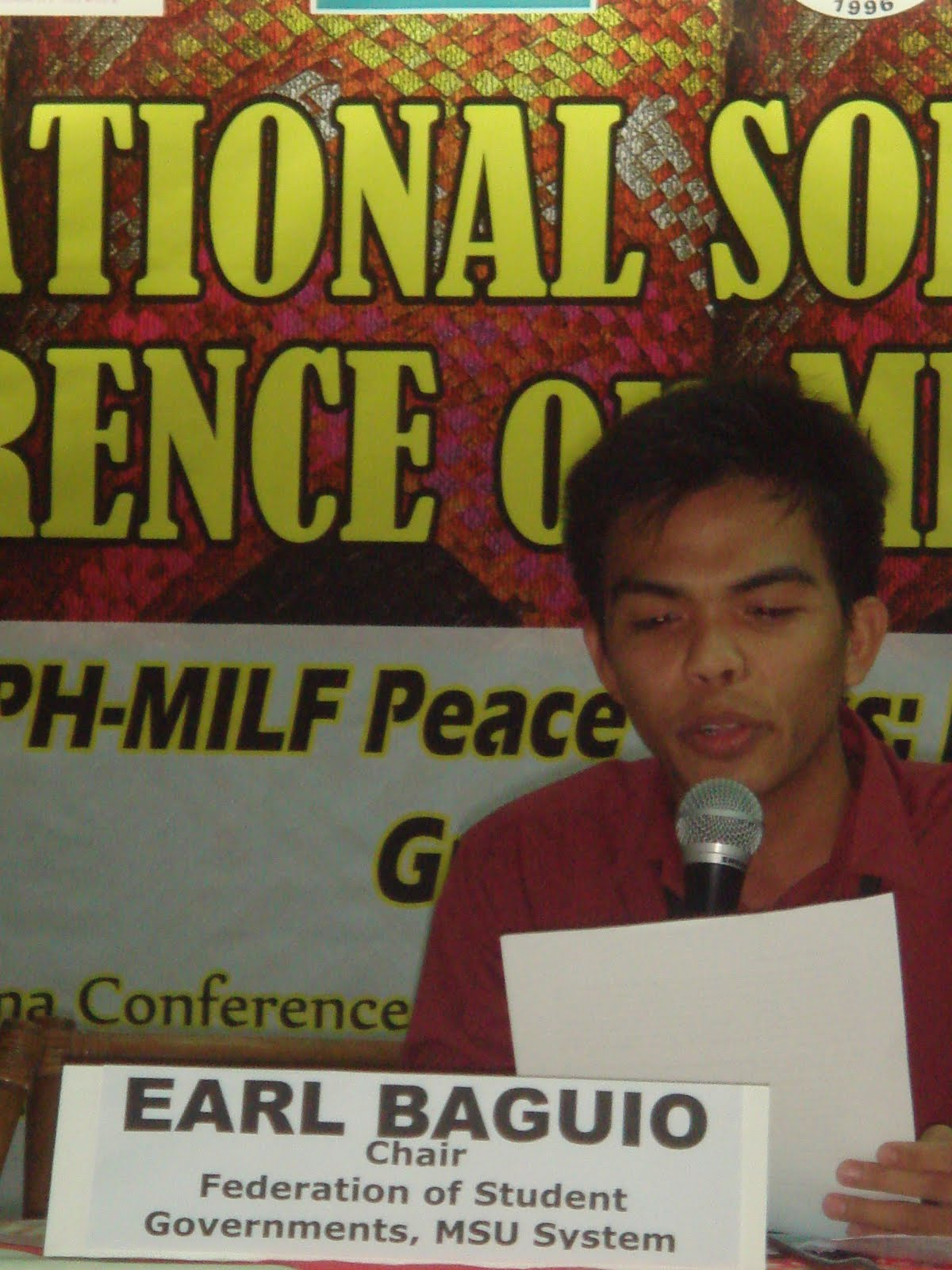
This was distributed on the 2nd National Solidarity Conference on Mindanao.


Saturday, 17 September 2011

The 2nd National Solidarity Conference on Mindanao Statement


FINDING THE COMMON GROUND IN THE GPH-MILF PEACE TALKS:
A View from the Stakeholders and Grassroots

We, the delegates of the 2nd National Solidarity Conference on Mindanao (NSCM II), representing religious leaders, business community, civil society organizations, indigenous peoples, women, youth, internally displaced persons and academe, gathered in Davao City on September 8-9, 2011 to tackle the theme, “The GPH-MILF Peace Talks: Finding the Common Ground;”

DEEPLY ENCOURAGED by the results of the latest Social Weather Stations (SWS) survey that 8 out of 10 Filipinos are hopeful that the GPH-MILF Peace Talks will result in a signing of a peace agreement; 

SERIOUSLY TAKE INTO ACCOUNT President Benigno Simeon Aquino III’s pronouncement that the strong political capital and public support that he now enjoys will be most effective up to 2013;  

STRONGLY AGREE with the statement of MILF Chairman Al Haj MuradEbrahim that “contentious and divisive issues in the peace negotiations can be resolved if both government and the MILF panels treat each other as partners instead of adversaries.”

With the unequivocal mandate from their principals to fast-track the negotiations, we believe that this is not the time for the parties to show off posturing or compete with each other’s intellectual prowess and superiority in terms of strategies and tactics in negotiation. This is the time to lay down the cards on the table, roll the sleeves up and start the work of honest, discerning and determined negotiations mindful of the following

PEACE OUTCOMES:
  • Address the aspiration of the Bangsamoro people for self-governance in accordance with their distinct identity, culture, religion and way of life;
  • Correct the imbalance of totality of relationship between Filipinos and Moros.
  • Give due recognition and justice to the ancestral homeland of the Moros.
  • Deliver good and effective governance, social services and foster economic development as soon as possible.
  • Recognize the Moro aspiration for separate national identity while retaining their Filipino citizenship.
  • Demilitarize, rehabilitate and normalize the situation in the conflict-affected areas.
  • Filipinos and Moros share the fruits of peace and become partners in development.
MINDFUL of the long years of negotiations that have spanned four administrations -- Fidel Ramos, Joseph Estrada, Gloria Macapagal-Arroyo, and now under President Aquino - it is prudent and wise that the peace panels build and harness the gains of the negotiations by closely working on the consensus points as building blocks for a negotiated political settlement.  We are confident that both parties will not squander the long years of past negotiations by starting from scratch. 

LISTENING to the presentation of the GPH panel, and at the same time paying attention to those that have not been said, we feel that the GPH panel has not yet fully laid down its cards. While it was quick to state that this is part of the negotiation process, it will save a lot of time and energies if the GPH panel, which is in the position to give in this negotiation, will be able to respond squarely to the proposals of the MILF.  Having described its proposal as the starting point, it will be more productive and honestly different, if GPH lays down its proposal not only from the starting point but also up to the ending point in order to spare the parties from what could be an unnecessary guessing game;

HEARING also from the MILF Peace Panel, we feel that the act of rejecting outright the proposal of the government was not faithful to the mutual understanding of the principals to fast-track the negotiations.  We urge the MILF to return to the negotiating table without pre-condition, extend the hand of dialogue and move heaven and earth in order to fulfill the political aspirations of the Bangsamoro people.  It is by talking and negotiating that we are able to narrow the gaps of the two proposals at hand;

FINDING the common ground to move forward has not been an easy task for the NSCM2 considering the fact that the official proposals of both parties up to now remain confidential and inaccessible to ordinary stakeholders.   From the little knowledge that we have gathered and given the limited access to official documents actually exchanged in the formal talks, we believe that in order to find the common ground, it is imperative for both parties to address some procedural, psychological and substantive issues that impede the way towards the common ground, such as:

Psychological
  • At this critical stage in the negotiation, it is important for the parties to increase confidence-building measures and cultivate the real essence of partnership that both the GPH and the MILF are proposing.  Accusations and counter-accusations will not help the seeming deadlock of positions.  “Talk to each other instead of talking about each other in the media” is the call of the day as suggested by the Bangsamoro civil society leaders.  This applies also to statements posted on social networking sites which spread like virus and are prone to misinterpretation and agitation.
  • Pounding the rido problem on the MILF like it is a conditio sine qua non to negotiated political settlement does not improve the call to develop genuine partnership.  We believe that the peace mechanisms on the ground such as the Joint Coordinating Committee on the Cessation of Hostilities and the International Monitoring Team are much more effective and competent to deal with the ground issues while the peace panels focus their attention on bridging the substantive gaps of the proposals at hand.

Procedural
  • The issue on which draft will be used as a working draft is for us irrelevant and counter-productive.  Why not use both drafts and from there develop the working draft together?  What is lacking in one draft can be filled in by the contents of the other draft and vice-versa.  This may sound too simplistic but as it stands now, there are two proposals on the table and both are not diametrically opposed but could actually feed on some gaps that each proposal may be found wanting.  For instance, as the two proposals stand, it cannot simply be a choice between  political solution or socio-economic development.  Both proposals can go together and will be mutually beneficial.  
  • At this stage in the negotiation, we also remind the GPH panel to activate its Advisory Team especially those coming from the House of Congress and Senate and the Judiciary, so that the other branches of government will already be on board and will hopefully cooperate in the eventual legitimatization process of the peace agreement.
Substantive
  • The Bangsamoro Commission as proposed by the GPH panel may be further developed and negotiated to address the task of “legalizing the peace agreement.”  Admittedly, there are proposals on the table that cannot pass the test of constitutionality, thus requiring possible amendments of the present constitution.  Representation in the Bangsamoro Commission as proposed by the GPH can be improved by ensuring that it will be led and determined by the Bangsamoro people taking into account participation in terms of gender, ethnic nationalities within Bangsamoro nation and sectoral interests.
Along these lines, the NSCM2 puts forward the following recommendations:

1.         For the parties to immediately return to the negotiating table and tackle the Draft MILF Comprehensive Compact and the GPH Three-for-One Solution with the end in view of bringing together provisions of the two proposals that are mutually acceptable to the parties.   We urge the parties to continue the efforts until they arrive at a mutually acceptable working draft. 

2.         Instead of debating what will be the name of the governing political entity – whether it will be a substate or a new, improved and reformed ARMM or “autonomy  in brackets” as described by the GPH panel – we recommend that the parties focus putting flesh and substance to the governance structure that will be suitable and acceptable to the Bangsamoro people.  The parties do not have to start from scratch here because the Draft Comprehensive Compact of the MILF has a very concrete proposal which can be further enhanced and reframed in a manner that can be easily understood by the layman.  Acknowledging the historical injustices committed against the Bangsamoro and indigenous peoples in Mindanao, as proposed by the GPH, is a very important element for healing and reconciliation.

This clearly resonates with the statement of President Aquino that "From the very beginning, the devil is in the details. Bakaiyong enhanced autonomy namin at sakaiyong sub-state nila, sapangalanmagkalayo, perosadetalye, bakamagkalapit. So, talagangitututoknatindoonsadetalye, ide-define ngbawatisangpanig, anobatalagaangposisyonnila, anobaiyongmgadetalye at palagaykomaramiangmakikitadoonnamagkakaparehas."


3.         To prevent a repeat of the Memorandum of Agreement (MOA-AD) of 2008,  we take the risk of being repetitious by reiterating the NSCM standing recommendation for the setting-up of a regular feedback mechanism and public consultations that should be institutionalized in the local government units, national government agencies, including the legislative and judicial branches of government.

FINALLY, for the GPH and MILF peace panels we pray that God will bestow upon you good health, wisdom, patience and creativity to become effective peacemakers.  We hope that your efforts will lead you to the common ground for a negotiated political settlement which will finally realize our shared aspirations for peace, justice, and social progress.  After doing everything that is humanly possible, we entrust everything to our Almighty God and seek out divine intervention that we may experience the joys of heaven, here on earth. 

Once again, we commit our skills, time, talents, energies, patience and creativity in order to fulfill the hopes of the majority of our people; that a peace agreement will not only be signed but also implemented during the term of President Aquino.  This is the best legacy that the son of Cory and Ninoy, our President, can give to the peoples in Mindanao.  

September 9, 2011, Davao City.


Friday, 9 September 2011

Mindanao Reader on the GPH-MILF Peace Talks


Good afternoon.

Kalinaw natong tanan.

Assalamu alaikum.

First I’d like to thank the organizers for having invited me in this forum. I will honestly share to you my thoughts on the present GPH-MILF peace talks from the perspective of a youth and student. I should confess that I’m no expert when it comes to the depth and width of the “Mindanao problem”, “Moro problem” or whatever you call it. Perhaps this is good because most of us the youth are not that informed or even aware on the complexities of this conflict and what are at stakes here. Hence, this presentation would represent the not-so-aware majority.

We are very busy uploading photos in facebook, downloading music and movies, and liking the statuses of our FB friends. Many of us also find pleasure in online games, DOTA, tetris, attending gigs, and malling. We can stay on-line for three hours or even more, but we’ll find it hard to stay in a two-hour forum on peace talks. As students, we are much focused in passing our subjects, getting good grades, in the hope that as we get good grades, we increase our chances of landing a good job in the future.

This is the sad reality of the status of most of the youth. We don’t seem to care on the events unfolding before our eyes, particularly the GPH-MILF peace talks. Of course, not all. I’ve also met fellow young people who care about this peace talks. But I could conclude they belong to the critical few.

In Mindanao State University-General Santos, the discussion on peace talks is limited within the classrooms---for those who are taking up AB Sociology, AB History, AB Political Science, AB Islamic Studies, and for those who are taking up History 3 (The History of Mindanao, Sulu, Palawan and Indigenous Peoples). I surmise that most of those who are taking up business, engineering, agriculture, education, and vocational courses are not interested in the peace talks. Perhaps it’s because they couldn’t connect the implications of peace talks vis-à-vis their daily living. The challenge for us, youth leaders is to provide venue for discussion to take place in a forum, seminar, or discussion group. These we will be doing this month and so on in various universities in Mindanao under Mindanao-one Youth Volunteers for Peace Network. It’s a newly organized group composed of campus and community youth leaders. It aims to “support the on-going GPH-MILF peace negotiations and ensure that the interests and welfare of the youth are reflected in the final agreement by influencing the process through advocacy work.”

But despite of the sad reality I’ve just mentioned, I still believe that the youth has a big role to play in the peace talks. Recognizing this, Prof. Cesar Adib Majul dedicated his book, Muslims in the Philippines, to the Muslim youth. Hashim Salamat also once said “we have planted the seeds of Jihad (struggle) and even if we pass away, the Bangsamoro people will carry on that Jihad towards the attainment of the goals and objectives of our struggle.” On this I believe he had the youth in mind.

We shall inherit whatever the result of this peace talks. It’s either you leave us a Mindanao where we (Muslims, Christian settlers, Indigenous peoples) could peacefully co-exist in the spirit of tolerance and justice; or you bequeath us a Mindanao filled with bloodshed and confusion, with people wallowing in a dire poverty and with my Bangsamoro friends carrying arms to continue the struggle.

It is the youth who are “severely affected by the conflicts as these could have limited the future possibilities for more peaceful and cooperative relations within society. It is indeed the youth who will play a key role in determining the relations in society will be more harmonious.” (Madelene Sta. Maria, 2003)

That’s why we are participating, and I’m one of those who responded to the call, realizing how great what is at stake here.

The GPH-MILF Peace Talks

As a student observer of the GPH-MILF peace talks, I am hopeful that both panels could come up with a win-win negotiated political settlement. I continue to hope taking into consideration what a deadlock or collapse of the negotiation could possibly result to. For those who are starting to lose patience in the negotiation, let us be reminded of Anwar Sadat, former President of Egypt, who once said, “Whenever the Israelis created problems during the peace negotiations, calculate again how much war had cost Egypt and Arab world since 1948.” (Sadat, 2009) In the Mindanao context, whenever there are problems or misunderstanding in the negotiation, calculate again how much war had cost Mindanao (and the whole Philippines) since 1970 (or even earlier than that).

The study of Campo and Judd (Salvatore Shchiavo-Ocampo, 2005)  revealed the following estimated cost of war since 1970’s:

  •  About $ 2-3 Billion in direct economic costs
  •     An estimated 120, 000 deaths and uncounted numbers of wounded and disabled;
  •    Displacement of more than two million people, of whom almost half in 2000 alone, during President Estrada’s “all-out-war”;
  • The emergence of “Muslim ghettoes” in various cities in Mindanao and elsewhere in the country made up of displaced persons and individuals forced out of their areas of residence owing to the disappearance of employment opportunities caused by the conflict;
  • The exodus of illegal Muslim migrants to the neighboring state of Sabah, Malaysia;
  •    Increased incidence of poverty;

Not to mention the psychological effects on the children who lost a father, a mother, a brother or a sister. That cannot be quantified. Also, the loss of opportunity to education: how can we go to school if there’s war in our place.

Patience. Calculate once again.

How the MILF sees it

Upon listening to the news and reading related literature, this is how the MILF sees the problem, or at least my belief on how they see it.

The problem is sovereignty-based. We were once sovereign with our Sultanates. Mindanao is our home. We were never once conquered. Where were you Filipinos when we were fighting against the Spaniards and Americans? We are not the foreigners in our own land. There were attempts also to eliminate us using ILAGA’s. We were massacred during Martial Law. Our culture, religion, and identity were not respected. With government policy, we were systematically marginalized and driven away from our lands, and were considered “second-class citizens without any role in national decision-making”. We suffer injustices in this government. And we could allow it any longer. And so we arm ourselves. We defend our identity and reclaim our sovereignty.

We are not even given the chance to determine our own future and political status. We are fighting for our right to self-determination, a right that is even recognized by the United Nation.

With regards to the ARMM, it is found wanting. It’s not autonomy at all. It does not fully embody the desires and aspirations of the Bangsamoro people. What we are fighting now is what those lacking in the ARMM: ancestral domain, genuine self-governance, resources-sharing.

And truth be told, much as you want, we don’t want another war. We don’t want to pass this on to the next generation. We want this to be resolved in our time. And so we are submitting this Comprehensive Compact in the negotiating table. This embodies the desires and aspirations of the Bangsamoro people.

We no longer demand Independence, but a “symmetrical substate-state relationships, wherein powers of the Central Government and state government are clearly stated, aside from those powers [on which we shall] jointly exercise; like Hongkong-China relationship. This had already been utilized as way to resolve conflicts in South Sudan and Northern Ireland.

In resources, we demand 75-25 sharing in favor of the substate within the ancestral domain. This is just but modest demand. Stop the oil exploration in Liguasan Marsh and in Sulu Sea, as the negotiation continues.

With regards to the MILF combatants, we don’t want them to integrate in the PNP or AFP like what was done to MNLF. They shall be the security force who shall maintain the peace and order in the substate.
T
his is a win-win solution “that would benefit not only Moros and the Indigenous peoples, but also the Filipinos and government.” If you accept this as a working paper, we could fast-track the negotiation and resolve this decades-old conflict.

And so the MILF submitted this Comprehensive Compact last February 9-10 during the 20th GPH-MILF Exploratory talks.  On the 21st Exploratory Talks (April 27-28, 2011), the GPH raised some queries regarding the Comprehensive Compact. It was then that they agreed that the GPH shall present their counter-proposal on the succeeding meeting. Then came the June 27-28 meeting, the GPH failed or deferred to present their counter-proposal, to the disappointment of the civil society and other stakeholders. The civil society released a position paper urging the GPH to submit its proposal.

On August 4, the nation was surprised that the President Aquino himself met with Chairman Al-Haj Murad in Tokyo, Japan. This increased the trust and confidence of the stakeholders and the MILF to the Pnoy Government. What was discussed in that meeting was confidential, but both agreed to fast-track the negotiation.

August 22-23, the 22nd Exploratory Talks, was the much-awaited date. In was in this time that the GPH submitted its counter-proposal. In the morning of that day (August 22), the OPAPP posted in their website the 11 Characteristics of the Government’s Counter-Proposal. And so I commented to myself, the negotiation might take a little longer. The MILF will surely be disappointed by this proposal.
This is how the government intends to solve the Mindanao Problem based on the 11 characteristics presented as I understand it. It’s like they are saying:

Putting aside your compact, we are presenting our counter-proposal, “an honestly different one”. This proposal contains a formula to achieve a comprehensive, just and lasting peace in our country.”
(1)You can trust this government and its good governance. We are sincere in dealing with you unlike the past administration. We would like to improve the quality of the lives of the people in partnership with you and rest assured that the Government will make use of the agencies to address the economic and social services for the Bangsamoro people.
(4 & 2)Let’s do the doables first. Let’s strengthen our relationship, develop understanding among Muslims and Christians and we’ll talk about the necessary Constitutional amendments in the future. Let’s not talk about the contentious issue yet on ancestral domain and substate concept.
(3)We are offering a solution that everybody will be happy: the MNLF, MILF, LGU’s. You should try to understand us that we are not dealing with the MILF alone, but with so many stakeholders. We are careful this time not to repeat the MOA-AD debacle. To reiterate, let’s work hand in hand to improve the socio-economic lives of our people.
(7)Let’s improve the ARMM and empower the Bangsamoro leaders. The ARMM per se is not a failure, though it has its own limitations. We should also consider that it failed partly because of its leaders and the national government. We will grant you a genuine autonomy where you could exercise your self-rule, etc, but please don’t insist on the substate yet. We can amend the ARMM organic act, to pave the way for a genuine autonomy.
(10)The substate proposal would not solve the problem. Let’s study this first and consult more stakeholders. Until we have a thorough consultation on this and increase of awareness on what is this all about, we cannot be with you on this substate. But please be assured that we understand the historical underpinnings of your proposal and your struggle for right to self-determination.
(11)We recognize your identity and history. We assure you that there shall be necessary retelling of your history which shall include its comprehensive narrative. We shall rewrite our books on history especially in the elementary and secondary education.
My guess is that the Government is trying to solve the Mindanao problem by addressing the socio-economic needs of the Bangsamoro people through a reformed and enhanced ARMM, in partnership with MILF and possibly with the MNLF. It’s hitting two birds in one stone. Constitutional amendment, to pave the way for substate, is not a priority of the Pnoy administration.
The MILF on the other hand has this reply: we’ve been there. Socio-economic services, ARMM…it didn’t work. Dropping our bid for independence, substate is our minimum demand to address our struggle for right to self-determination. We already agreed to talk about the ancestral domain with the last administration as one of the consensus points, and now you’re easily putting it aside without even commenting on the Comprehensive Compact?
 Finding the Common Ground
The best thing that happened with the latest exploratory talks is this: it unveiled the thoughts of the government. Now starts the real negotiation. Where do we go from here? What is the common ground?
On this may I express out my humble opinions:
1.      Both panels need to be more patient. MILF has been negotiating for the past fourteen years. Perhaps they won’t mind adding a year or two in trying to come up with a win-win solution. The GPH panels are new. The Pnoy administration is more than a year old. This should be taken into consideration by the MILF. They are not talking to Mr. Silvestre Afable and GMA. They are talking to new minds, with new different framework.
2.       Both sides should maintain their trust and confidence, avoiding unnecessary remarks in the media which might cause misunderstanding with the other party.
3.      Lay down to the table the two proposals. How about both sides making comment to each other’s proposals at least, and explain why the substantial points are negotiable or non-negotiable.
4.      A third party may conduct a thorough research to determine what really is the perception of the Bangsamoro people in the ARMM with regards to the proposed substate.  Should this be confirmed that it’s the desires of the large majority of the Bangsamoro, then the Government might reconsider her position.  Until now this presentor still wonders if this really is what the people from Sulu, Tawi-tawi, Marawi, Maguindanao, etc, wanted.
5.      Solidify the relationship between the MNLF-MILF. This is the missing link in the negotiation (in our desire for a peaceful Mindanao). Can the negotiated political settlement produce a lasting peace without the role of the MNLF in the process or at the outcome? How is the tri-partite review on the 1996 Final Peace Agreement going on? Can we have a peaceful Mindanao without the unity of the Bangsamoro people, specifically MILF and MNLF? Chair Murad and Chair Misuari should start talking to each other for the sake of the Bangsamoro people whom they both claim to legitimately represent. This perhaps is the main reason why the government doesn’t consider the proposed substate as a viable solution.
6.      Can the civil society at least have a copy of the Government’s 3-for-1 proposal or its substantial points? Yes I understand the importance of the confidentiality of the negotiation to give both panels flexibility. But at this point in time, most of the Filipinos at least have an idea on the proposed substate stipulated in the Comprehensive Compact through media, while we don’t have any specific details of the Government’s. This is for the Civil Society to have an informed recommendation and not be left out on the development of the talks.
In closing, real negotiation has just started. This is the chance of Chair Murad and Pnoy to effect a just and lasting peace in Mindanao; same with Mr. Iqbal and Mr. Leonen. War is not an option. It should not be an option. Let the negotiation continue. We the youth are supporting the peace process together with all of you who are attending here.
I believe we can have peace in Mindanao. Paraphrasing Jimmy Carter’s statement--The blood of Abraham, God’s father of the chosen, still flows in the veins of Bangsamoro and Christian settlers in Mindanao, and too much of it has already been spilled. The spilled blood in the Land of Promise still cries out to God---an anguished cry for peace. “It is time to replace anguish with joy and celebration.” (Carter, 2009)
Peace is within reach. God bless Mindanao.
Thank you for listening.

Works Cited

Carter, J. (2009). My Hope For Peace. New York: Simon & Schuster.
The original text: The Blood of Abraham, God's father of the chosen, still flows in the veins of Arab, Jew, and Christian, and too much of it has been spilled grasping for the inheritance of the revered patriarch in the Middle East. The spilled blood in the Holy Land still cries out to God--an anguished cry for peace. It is time to replace anguish with joy.

Madelene Sta. Maria, P. (2003). The Filipino Youth's Participation in Conflict (A Paper Presented in the Conference on Global Perspectives on Youth Conflict, March 10-14, 2003). Retrieved March 28, 2011, from web.gc.cuny.edu/globalyouth/Chapters/StMaria.doc

Sadat, J. (2009). My Hope for Peace. New Yok City: Free Press.

Salvatore Shchiavo-Ocampo, M. J. (2005, February). The Mindanao Conflict in the Philippines: Roots, Costs, and Peace Dividend. Retrieved March 28, 2011, from www.internal-displacement.org/8025708F004CE90B/.../WP24_Web.pdf


The text on 11 Characteristics of the GPH 3 for 1 proposal was retrieved at OPAPP.gov.ph
The text on 11 Features of the MILF Comprehensive compact was retrieved from Mindanews.com

 This piece was shared by a youth representative during the Second National Solidarity Conference on Mindanao on September 8, 2011, 5th Floor, Karpentrade Bldg, Mac Arthur High, Matina, Davao City. The event was jointly initiated by Mindanao People’s Caucus, Bishops Ulama Conference, Philippine Council of Evangelical Churches, Mindanao Solidarity Network, Consortium of Bangsamoro Civil Society, and International Alert.


Sunday, 21 August 2011

Mindanao Reader on the Current GPH-MILF Peace Talks


Just wanna share this post from the Office of the Presidential Adviser on Peace Process. It describes the characteristics of the Government's counterproposal on the MILF's Comprehensive Compact.
Eleven Characteristics of the Government Proposal
Posted on Monday, 22 August, 2011 - 12:17 at OPAPP website.1.  The proposal contains a formula to achieve a comprehensive, just and lasting peace in our country.  It presents a practical and bold approach to create the conditions for meaningful and effective governance through a sustainable partnership that will bring in the needed social services and projects that provide the springboards for sustainable economic development. Unlike past administrations, this government is poised to use its massive resources and its theme of good governance for this undertaking.
2.  The proposal is founded on partnership.  It has the potential to create mutual trust amongst peoples of our country, heal the wounds of conflict, mobilize and capacitate Bangsamoro leaders and therefore increase understanding among all Filipinos of every ascribed identity.  It is a partnership that will therefore set the stage for more enlightened political discussion amongst all parties.  This discussion, in turn, will effectively point the way to the realization legal reforms that may be truly necessary.
3.  The proposal is politically comprehensive. It contains ideas for reforming the relationship between national and regional government.  But, it also meets the challenge of finding viable mechanisms that increase the possibility for finding convergence of programs among all those who claim to represent the Bangsamoro, Christian settlers and indigenous peoples within the conflict affected areas. The reform of political relations takes into account the realities of socio-economic underdevelopment, demographic shifts and diversity across communities.
4.  The proposal works with what is available and doable within the next few years. It does not start with contentious and divisive issues whose resolution may not be realizable as yet.     The proposal thus realistically meets the urgent and present needs of many communities who were the victims of colonial oppression, postcolonial neglect, misguided leaders and past abuses of some national leaders while preparing for the viability of longer term and mutually agreed upon solutions to the Bangsamoro problem.
5.   The proposal works on the premise that the form of government that should be entrenched should be able to deliver good and effective governance, social services and foster economic development within the soonest possible time.
6.  The proposal shows government’s awareness of the extent of the legal and political powers of the President.  However, it is also a political document that is intended to cause public discussion that can support future debates, when it becomes necessary, in other constitutional forums such as the legislature and the courts.
7.  The proposal recognizes the identity of the Bangsamoro and its history. This proposal takes this history into consideration but avoids simplification of the solutions for a complex and myriad problem.  The Autonomous Region for Muslim Mindanao (ARMM) may have been a failed experiment in the past; but the current proposal is based on a more balanced understanding of whether its past failure was due to its structure and the systems that it spawned or the quality of the past national or regional leadership. This proposal presents the possibility of a more empowered, more workable, and thus, more genuine autonomy of a Bangsamoro region.
8.  The proposal continues a discussion on how revenue and the use of resources could ensure enhance autonomy.  However, it also introduces the idea that ecological and cultural diaspora as a result of unbridled exploitation of resources have effects far beyond political boundaries.  The proposal therefore includes a system of cooperation between the national and regional government to ensure sustainable futures.
9.  The proposal starts a discussion on the process of normalization.  This includes weapons disposal, disarmament, demobilization and rehabilitation of combatants.  It also includes processes to achieve restorative justice.
10.  The proposal is founded on the belief that legal reforms do not by themselves bring about social change.  Rather, this proposal proceeds from the fundamental faith that no legal reform can take root without genuine public consensus.
11.  The proposal seeks to correct our historical narratives so that it truly acknowledges the struggles of all Filipinos including those with ascribed Bangsamoro identity.  It believes that the various struggles of each group of people within our State contribute to the latter’s strength.  The proposal seeks to entrench the retelling of our true historical narratives across all generations through existing mechanisms within the powers of government.
My limited view on this on each specific items, which every high school student could understand.
1. It's like saying that you can trust this government and its good governance. We are sincere in dealing with you. We would like to improve the  quality of the lives of the people in partnership with you and rest assured that the Government will make use of the agencies to address the economic and social services for the Bangsamoro people.
2. Let's do the doables first. Improve the region (I'm referring to the ARMM) and empower the Bangsamoro leaders. However, we are not telling you that you totally drop the substate proposal. For the mean time, let's do these first. Let's strengthen our relationship, develop understanding among Muslims and Christians and we'll talk about the necessary Constitutional amendments in the near future.
3. We are offering a solution that everybody will be happy: the MNLF of Misuari, MILF, LGU's which includes Pinol, Congressmen like Dimaporo. You should try to understand that we are not dealing with the MILF alone, but with so many stakeholders, we are careful not to repeat once again the MOA-AD debacle. To reiterate, let's work hand in hand to improve the socio-economic lives of our people.
4. Let's address first the emergent problems. Let's talk later about the proposed substate, the relationship about the proposed substate and the Central government, and ancestral domain issue.
5. Let's reform the ARMM as a mechanism to address poverty and improve the lives there, urgently.
6. Can't get the gist on this. It's like, give the President much power to effect reform, or we limit the power of the Philippine Government in the ARMM. This will elicit questions on constitutionality, but we see this would work. We might come up with a law to effect this one.
7. We recognize your identity and history. Let's empower the ARMM. The ARMM per se is not a failure, though it has its own limitations. We should also consider that it failed partly because of its leaders and the national government. We will grant you a genuine autonomy where you could exercise your self-rule, etc, but please don't insist on the substate yet. This will need a law amending the ARMM organic act.
8. Here's our proposal on financing the reformed ARMM and wealth-sharing.
9.  You disarm in time. Here's our offer for your combatants which we believe is just.
10. The substate proposal does not solve the problem. Let's study this first and consult more stakeholders. Until we have a thorough consultation on this and increase of awareness on what is this all about, we cannot be with you on this substate. But please be assured that we understand the historical underpinnings of your proposal and your struggle for right to self-determination.
11. We recognize your part in history. We assure that there shall be necessary retelling of our history which shall include the comprehensive narrative of your history. We shall rewrite our books on history especially in the elementary and secondary education.
The Government is very careful this time on its counter-proposal. They do not address head-on the proposed Comprehensive Compact of the MILF which includes the substate concept, but they highlight the need to address the socio-economic needs of the Bangsamoro people through a reformed ARMM. However, they do not totally drop the substate proposal. They prefer not to focus on it yet.
The MILF I'm sure will have a hard time accepting the Government's proposal. I hope I'm wrong. They've been struggling for so long, and they are hoping that the Government will be amenable to the substate concept,because they believe this is the only way to address the desires and aspirations of the Bangsamoro people and their right to self-determination. They are hoping also that the struggle will not be passed on to the Bangsamoro youth. They are trying to resolve this in their lifetime. Whatever happens in the negotiation I trust that the MILF and GPH will not resort to armed battle in the ground. I trust that both sides will continue to talk and will not resort to media grandstanding.
We continue to believe that this problem can be resolved peacefully through peace talks. I just hope that both sides will continue to be patient. We can't afford another bloodshed. We are nearly there.
God bless Mindanao. May He grant more wisdom to GPH and MILF peace panels to come up with a win-win peaceful solution.

Related Posts Plugin for WordPress, Blogger...